
Latest Comet 3I/ATLAS news: One day until the comet is closest to Earth!
Refresh
What time is comet 3I/ATLAS’s closest Earth approach?
If you’re hoping to try and watch comet 3I/ATLAS’s closest approach to Earth live online, it would help to know exactly when to tune in. But don’t worry, space fans, we’ve got you covered.
As Space.com’s Daisy Dobrijevic reports, comet 3I/ATLAS closest point to Earth will occur at 1 a.m. EST (0600 GMT) as it zips past our planet at a whopping 144.1 thousand mph (231.9 thousand kph). At the time, it will be 168 million miles (270 million km) from Earth.
You’ll be able to watch the flyby live online starting at 11 p.m. EST (0400 GMT), courtesy of the Virtual Telescope Project. Comet 3I/ATLAS is too far from Earth to see with the unaided eye, and you’d need a large telescope to try and spot it, so the livestream may be one of our last public looks at the interstellar visitor as it passes by.
How fast is interstellar comet 3I/ATLAS going?

Having made its closest approach to the sun on Oct. 30, comet 3I/ATLAS is now on its way back out of the solar system, charging away from our parent star at a breathtaking speed of 144.1 thousand miles per hour (231.9 thousand kilometers per hour) as it heads towards interstellar space.
The ancient interloper is already well beyond the orbit of Mars ahead of its closest pass of Earth on Dec. 19. Its next planetary rendezvous will be with Jupiter in March next year, when it will pass 36 million miles (58 million kilometers) from the gas giant, before continuing on an incident-free course to exit the heliosphere.

Anthony Wood
Spacecraft reveal 3I/ATLAS’s X-ray signature

Scientists are working hard to collect valuable data on 3I/ATLAS’s spectral fingerprint before it disappears from our skies for good, in an attempt to shed light on the composition of the distant star system where it was born.
The European Space Agency’s XMM-Newton observatory and the Japanese space agency-led X-Ray Imaging and Spectroscopy Mission (XRISM) revealed a vast 250,000 mile (400,000 kilometer) X-ray glow extending from the comet’s nucleus. An analysis of this X-ray light, emitted by gasses interacting with the solar wind, will help scientists understand how the comet is being influenced by the high-energy environment surrounding our star after its marathon voyage through interstellar space.
Read the full story here: Scientists detect X-ray glow from interstellar comet 3I/ATLAS extending 250,000 miles into space.
Anthony Wood
Interstellar comet 3I/ATLAS just revealed its secret wobble
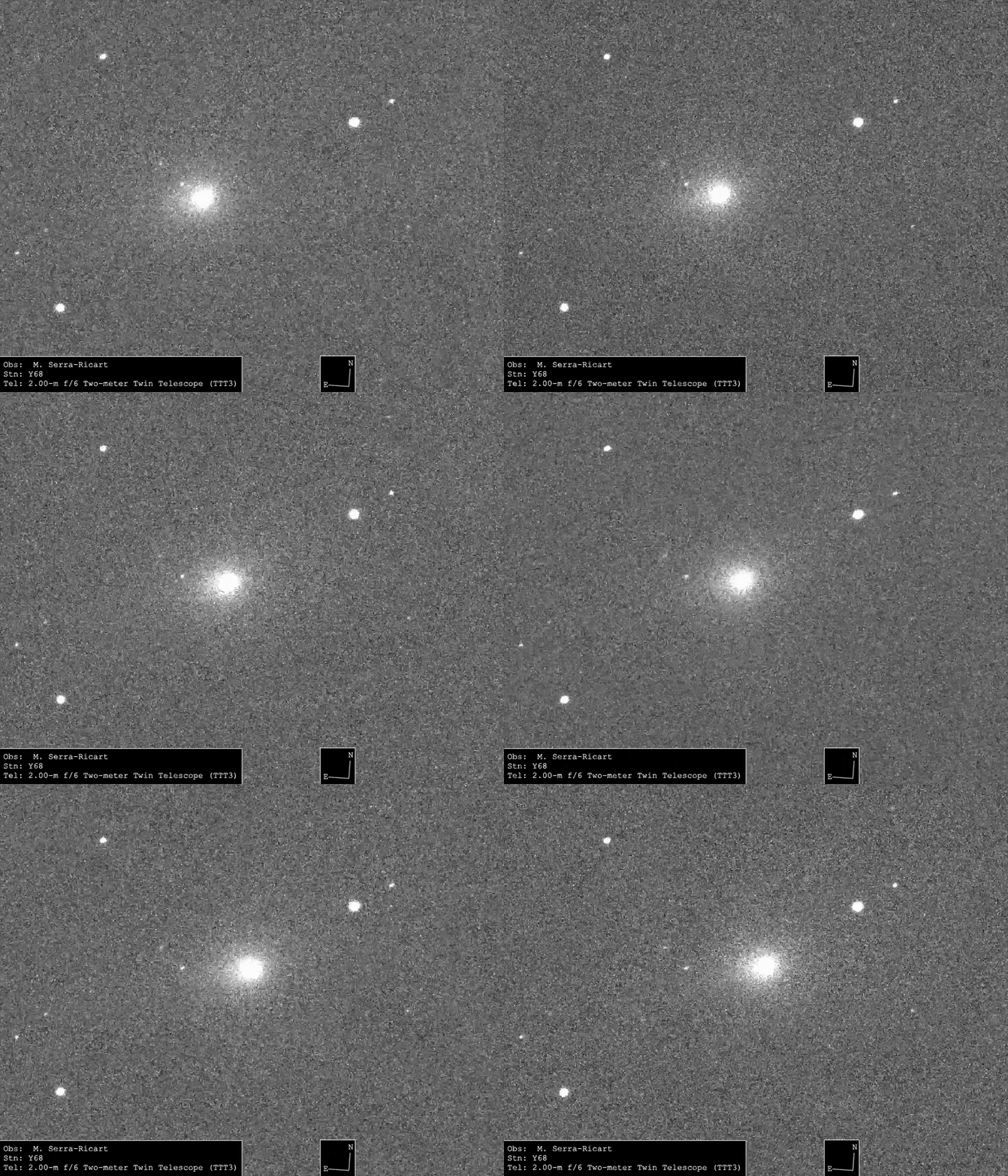
Astronomers have spotted the first-ever wobbling jet from an interstellar comet and it is changing how we understand visitors from beyond our solar system.
Using the Two-meter Twin Telescope at Tenerife’s Teide Observatory, researchers detected a faint jet of gas and dust blasting from 3I/ATLAS, slowly wobbling as the comet rotates. Crucially, that rhythmic motion confirms that 3I/ATLAS spins once every 14-17 hours, making it the first interstellar comet with a directly measured rotation period tied to visible activity on its surface.
What surprised scientists most is how familiar the behavior looks. Despite forming around another star, 3I/ATLAS behaves much like comets born closer to home. Scientists describe it as an “extraordinarily normal interstellar comet,” complete with sunlight-driven jets.
The findings of this study are published in the journal Astronomy & Astrophysics.

Daisy Dobrijevic
How comet 3I/ATLAS captured our hearts with mystery

We’ll admit it: We would love it if the interstellar comet 3I/ATLAS really was an alien spaceship, but at the end of the day, it’s still a comet. Yet that does not mean 3I/ATLAS isn’t still completely amazing; otherwise, we wouldn’t have covered the comet’s passage through our solar system as we’ve done over the last six months.
Why not read up on the four key things that NASA revealed about the comet in a long-awaited briefing following the reopening of the U.S. government in November? At the event, NASA Associate Administrator Amit Kshatriya explained “we very much want to find signs of life in our universe,” before re-iterating, “but 3I/ATLAS is a comet”.
Full article: 4 key things NASA just revealed about the interstellar comet 3I/ATLAS.

Tariq Malik
Is comet 3I/ATLAS really a comet?

You’ve probably heard all the theories: It’s really an alien spaceship. It’s changed direction. It spat out a tiny spacecraft.
Well, NASA recently made it official: Comet 3I/ATLAS is just what it looks like – a comet from beyond our solar system. In late November, NASA held a televised press conference to put the comet 3I/ATLAS rumours to bed.
“It looks and behaves like a comet, and all evidence points to it being a comet. But this one came from outside the solar system, which makes it fascinating, exciting and scientifically very important,” NASA Associate Administrator Amit Kshatriya told reporters during the press briefing.
Here’s the full story on NASA’s take on comet 3I/ATLAS.
Tariq Malik
How far is Comet 3I/ATLAS from Earth right now?

As of 12 p.m. ET today (Dec. 17), Comet 3I/ATLAS is about 166.9 million miles (268.6 million kilometers) from the Earth and closing, ahead of its closest approach on Dec. 19.
You can track comet 3I/ATLAS yourself with the help of NASA’s Eyes On The Solar System webpage, which has a “Distance Tool” that allows you to calculate the separation between the comet and any other solar system object included in the simulation.
Tariq Malik
How to watch the comet 3I/ATLAS Earth flyby

The interstellar comet 3I/ATLAS will make its closest pass by Earth on Dec. 19, and you’ll be able to watch its approach live online, but you’ll need to tune a bit earlier than you’d think.
Astrophysicist Gianluca Masi of the Virtual Telescope Project will host a free livestream of comet 3I/ATLAS on Thursday, Dec. 18, at 11 p.m. EST Dec. 18 (0400 GMT on Dec. 19), weather permitting. You can watch the livestream here on Space.com.
Masi’s livestream will run through comet 3I/ATLAS’s closest approach at 1 a.m. EST (0600 GMT), but will depend on good weather from his telescope’s observing site.
The comet is too faint to be seen with the naked eye and will be challenging even for small backyard telescopes. Under dark skies, observers with a telescope of 8 inches or larger may be able to spot it as a faint, fuzzy patch of light. Read how to watch the comet 3I/ATLAS flyby live online.
Tariq Malik
Who discovered Comet 3I/ATLAS?

If you’ve been as captivated as us here at Space.com by comet 3I/ATLAS’s trip through the solar system, you might find yourself wondering exactly how it was discovered. So did we, which is why our own Kenna Hughes-Castleberry took it upon herself to find out — and the result was eye-opening!
What seemed like a normal July night ended up making history when astronomer Larry Denneau at the University of Hawaii’s Institute for Astronomy discovered a new moving object while scrolling through data from ATLAS — the Asteroid Terrestrial-impact Last Alert System.”I was the person reviewing at the time that 3I popped out of the pipeline,” Denneau told Space.com “And at the time, it looked like a completely garden variety new Near Earth Object.”
Read the full story behind the discovery of comet 3I/ATLAS here.
Tariq Malik
Comet 3I/ATLAS: An early Christmas gift for scientists

When 3I/ATLAS is closest to Earth on Dec. 19, all the features that we are looking for will be easier to detect with our telescopes and it has scientists as eager as kids on Christmas.
Comet 3I/ATLAS is the third large interstellar visitor (an asteroid or a comet) known to have passed through our solar system from beyond our solar system. By studying it closely, astronomers hope to learn more about other celestial objects through telescope observations.
“It has since been careening through the interstellar medium of the Milky Way galaxy for billions of years,” Darryl Z. Seligman, an assistant professor of physics and astronomy at Michigan State University, wrote in an op-ed. “And we get front-row seats to watch as it gets close to our sun, for what is almost surely the first time it has ever gotten close to a star”.
Read the full op-ed on the comet’s Earth flyby here.
Tariq Malik
Comet 3I/ATLAS has last hurrah this week

Good morning, Space Fans! As of today, we are T-2 days until the interstellar comet 3I/ATLAS makes its closest approach to Earth and then we’ll have to say our goodbyes.
Whether or not you’re in Team Comet or Team “Could It Be A Spaceship?” 3I/ATLAS has dominated the comet conversation since its discovery on July 1 by the ATLAS telescope in Chile. On Friday, Dec. 19, 2025, the comet will be at its closest to Earth at a range of roughly 168 million miles (270 million kilometers) before heading out of our solar system for good.
Over the next two days, we’ll chronicle comet 3I/ATLAS’s Earth flyby, and revisit its passage through our solar system — and its legacy.
Read our full preview of the comet’s Earth flyby.
Tariq Malik
You must confirm your public display name before commenting
Please logout and then login again, you will then be prompted to enter your display name.