
‘It’s not a phony consultation’: Ray-Mont container yard project raises concerns as
With politicians and locals highly critical of the project, the city of Montreal is largely powerless in reining it in.
Article content
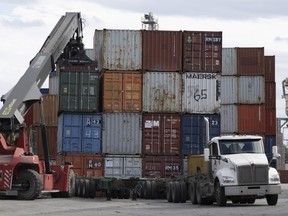
Public consultations launched Oct. 16 amid widespread local opposition to plans for a container yard in Mercier—Hochelaga-Maisonneuve. But despite the overwhelmingly negative response, the city’s hands are just about tied when it comes to imposing limits on the project.
The hotly contested project has been the subject of two court judgements, a $343-million lawsuit and a $17-million dollar settlement.
Advertisement 2

Article content
In 2017, the city of Montreal turned down a permit request from Ray-Mont Logistics to build a container trans-shipment yard on a lot less than 100 metres from a residential area. In 2018, a Superior Court decision found that Ray-Mont was entitled to build the project, a decision later upheld in the Court of Appeal. Ray-Mont then sued the city for $343 million, later settling for $17 million.
The settlement obliges the city to approve several zoning changes requested by Ray-Mont. The municipal charter, meanwhile, requires the city to submit those changes to public consultation.
“It’s not a phony consultation,” Philippe Bourke, president of the Office de consultation publique de Montréal, told The Gazette. “People still have the right to intervene and suggest things.”
The consultation will end with a report delivered to the city, which Bourke said could ask it to relay a certain message to Ray-Mont, for example. Renegotiating the settlement may also be an option, he said.
Citizens and opposition politicians have raised numerous concerns over the project, citing noise pollution, worsening air quality and a “heat island” effect as possible consequences of the extended operation hours and increased trucking inherent in the project.
Advertisement 3
Article content
Ray-Mont Logistics, for its part, has asserted that the project will offer a net benefit to Montrealers. It says that by moving its operations next to the port, it can significantly decrease truck traffic on Notre-Dame St.

Today’s One Read
Article content
Advertisement 4
Article content
Parti Québécois leader Paul-St-Pierre Plamondon, whose riding of Camille-Laurin encompasses the container yard project, has been vocal in his opposition to it. “Lengthening the company’s hours of operations would be unacceptable,” he wrote on X Oct. 15. “Citizens of the east of Montreal deserve to have their quality of life protected!”
Québec solidaire MNA Alexandre Leduc has also supported local opposition to the project. He attended the first round of consultations Oct. 16.
Local opposition to the project has come largely through the group Mobilisation 6600, which has organized demonstrations against Ray-Mont and had members present at the consultation.
The project will have “a big, big impact on our lives. It degrades our quality of life, it has a direct effect on our health,” Mobilisation 6600 member Élisabeth Greene told The Gazette.
“We know the city did what it could” in its efforts to limit the project, she said. “The city negotiated over almost a year with a knife at its throat. (Ray-Mont Logistics) is getting everything it wanted for the cost of a lawsuit.”
Advertisement 5
Article content
Residents of the area, neighbouring the Port of Montreal, have long lived with the consequences of heavy industrial activity, Greene said. She said that activity has already contributed to a “heat island” effect, generated noise and air pollution and caused the degradation of natural spaces.
“We’re asking for that to be limited from here on out,” Greene said. “The sector is saturated with industrial activity.”
A Ray-Mont representative, meanwhile, told The Gazette that many of residents’ concerns are misplaced.
The logistics company has already started some operations on a small portion of its lot, said Julien Nepveu-Villeneuve, a public affairs consultant working for Ray-Mont. He said noise studies have shown levels to be within legal limits, which he said should alleviate concerns around extended hours. The company doesn’t intend to increase operations beyond initial planning, but will spread operations out over longer hours, Nepveu-Villeneuve said.

He said the project would reduce the distance between the container yard and the Port of Montreal by 88 per cent. Trucks are currently required to drive 11 kilometres along Notre-Dame St. between the yard and the port, he added, asserting that the project would result in a one-third decrease of truck traffic on the congested street.
Advertisement 6
Article content
Mobilisation 6600 and Plamondon have also called on the province to order an environmental assessment from the Bureau d’audiences publiques en environnement (BAPE).
In this case, such an assessment was not required, but remained an option in the province’s toolkit.
“We deplore the fact that the province refused to submit the project to a BAPE,” Greene said.
The Quebec Ministry of the Environment declined The Gazette’s request for an interview. In a statement, the ministry said the project is located in an industrial area exempt from BAPE review. The statement asserted that Ray-Mont’s activities would be “properly supervised,” and its impact on the environment “minimized.”
The OCPM met with Ray-Mont Logistics and municipal representatives ahead of the run-up to public meetings.
With Mobilisation 6600 a major presence in the fight against the container yard, Bourke said the commission opted to meet with them, too. “It was something that we don’t usually do, but, given the nature of the file, the commission judged it important,” he said.
The Oct. 16 meeting saw both local officials and Ray-Mont present plans for the container yard. Questions from the public were overwhelmingly critical of Ray-Mont and its representatives were often met with jeering.
Advertisement 7
Article content
Élise Guerrero, who said she’d lived in the neighbourhood all her life, said she was no longer sure she would stay “in a neighbourhood that’s destroying my quality of life little by little.”
She asked Ray-Mont representatives whether they saw it as “morally acceptable to skip regulations to make money,” while people are “suffering from your project.”
Nepveu-Villeneuve told her that Ray-Mont was aware of widespread opposition to the project, but said the site was ultimately zoned for industrial use.
Ray-Mont had already put a lot of work into cleaning up the site, which had been contaminated over decades by a steel foundry, he later told The Gazette. “We’re aware that there are citizens in the area who had other ambitions for the site, who wanted the site to become a park, for example. But we acquired a contaminated site zoned for industrial use, so we’re operating with the site’s industrial zoning and baggage,” he said.
Consultations will continue into November, with a first session reserved for the public to offer its opinions scheduled Nov. 12. Details are available at ocpm.qc.ca/fr/ray-montlogistiques.
Recommended from Editorial


Advertisement 8
Article content
Article content