
Montrealer Ling pens The 51st State Votes: Canada Versus Donald Trump
Last April 20 million Canadians cast ballots in an election defined by economic turmoil, a cost-of-living crisis, and threats of outright annexation by the United States. It was an election that, more than any vote in recent memory, split Canadians down the middle.
On one side were voters convinced that their own country had been broken by years of abuse and mismanagement—Canadians who no longer believed in the state’s ability to do its job, let alone build big things, and never mind fight and win a trade war. On the other side were those motivated by the existential threat posed by a single man: Donald Trump.
Montreal journalist Justin Ling’s new book The 51st State Votes: Canada Versus Donald Trump, is the latest addition to the Sutherland Quarterly series and was released at the end of August.
Reported on the ground over the full 35-day campaign, in The 51st State, Ling details how Mark Carney vs. Pierre Poilievre became a proxy fight over two anxieties: those convinced that their own country had been broken by years of abuse and mismanagement, and those motivated by the existential threat posed by a single man: Donald Trump.
This is a sharp, witty, 100-page account,. What the book provides is: fresh post-election analysis from inside the campaign trail, written to be read in one sitting; a cross-border lens on how Trump reshaped Canada’s politics – and how Canada answered back and it is a timely peg for coverage of U.S.-Canada relations, populism, tariffs, and 2026 U.S. midterm positioning.
I sat down with Ling for a compelling conversation about Canadian politics. A native of Cape Breton, the 34 year old resides in the Rosemount area and is an avid biker. In recent years his journalistic travels have taken to places like Ukraine and Taiwan.
“The book is very much designed to be polemic,” Ling told me. “It is short and sweet, but packs a punch. Yes, it gets people in the mindset that the election is over, but the fight is not. What I want people to take away is the existential threat we are facing. We are not living in a normal political environment. And Mark Carney is not being very honest about the sacrifice and hurt we are going to experience. As Donald Trump faces the economic consequences of his own actions, he will keep shaking down his allies for more money.”
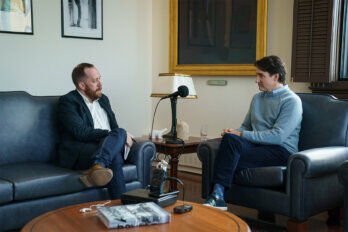
Justin Ling in conversation with Justin Trudeau.
Justin Trudeau
Of course any book about the Canadian election must begin with former Prime Minister Justin Trudeau whom Ling said did everything he could to rationalize staying in office, despite all of the signs that he was weighing his party down. “Even as the Canadian public soured on his government, he insisted he was uniquely qualified to do battle with his Conservative foe, Pierre Poilievre,” Ling writes. “He had won three consecutive elections by convincing the voting public that his center-right opponent had slid far enough along the ideological spectrum to pose a threat to Canada as we know it. At Rideau Cottage, the prime minister still sounded keen to have a fourth go. ‘My friends,’ he told the nation on that frigid day in January, ‘as you all know, I am a fighter.’ In its day-to-day operations, Trudeau’s government was insular and self-perpetuating. But when big decisions had to be made, it fell back to a good instinct: to call around to outsiders for advice. When scandal hit and things looked dire, the prime minister and his senior staff would go through the phone tree: What should I do? Who should we add to cabinet? Should I resign? Unfortunately, it also developed a habit of ignoring that advice. When Trudeau called up one of his predecessors, Jean Chrétien, he got an unvarnished take on his chances in the next election: ‘You’re toast!’ said the former prime minister. Still, Trudeau continued to tell anyone who would listen that he, and only he, could beat Poilievre.”
Ling ended up scoring an interview with Trudeau. “The prime minister was charming and engaging as ever,” he wrote. “ He was also delusional. He was convinced he could win, even while down more than twenty points in the polls. He was positive that public disgruntlement with his government was already fading, even as it was clearly increasing. He was sure that he deserved credit for work half finished. The problems facing Canada were not all Trudeau’s fault. The pandemic, the price of oil, the war in Ukraine, trade conflicts with China and India—none were primarily Trudeau’s doing. But he proved uniquely skilled at ignoring those problems, blaming others, and offering solutions ill-suited or insufficient to address them. Some things were his fault. Canada’s declining productivity, mounting debt, and growing inability to get things built were all symptoms of a government that spent a lot, added plenty of new processes, yet produced less and didn’t seem to care to change its ways.
“Certainly, there were people trying to make Trudeau change. A series of bruising by-election losses across the country—Toronto, Montreal, Vancouver—were clear signs that Canadian voters wanted him to leave. Voters were making their displeasure heard by their MPs as well. While the inner sanctum of Trudeau’s team seemed primarily concerned with the buzz on Twitter and Instagram, the Liberal caucus, which shrunk from 157 to 153 in the course of 2024, was feeling anxious.”
The Carney Factor
Ling notes that from the beginning, the race to replace Trudeau was a fait accompli. A cadre of politicians, past and present, threw their hats in the ring, laboring under a mix of self-delusion, ego, and passion. Only four made it to the ballot: Frank Baylis, Karina Gould, Chrystia Freeland, and Carney. “Carney did his best to make the race interesting, although that was clearly not his intention,” stated Ling.
The tentpole of Carney’s campaign was his vow to build “one Canadian economy, not thirteen.” That meant tearing down interprovincial trade barriers, improving labor mobility, and reducing the red tape that stymies commerce between provinces and territories, Ling explained. This would allow trucks to travel across provincial lines without worrying about changing regulations, doctors to pick up and move to where the work is, and businesses to ship goods easily from one coast to another.
Canadians, Ling wrote, bolstered their sense of security by telling themselves that Trump wasn’t serious. Or that he was too inept to do any real damage. Or that the checks and balances of American democracy would constrain him. But, day by day, that secure constituency shrank. More and more signed up to the idea that Trump represented a real, existential threat to Canada. To the whole world. When Carney called the election, just two months into the second Trump administration, America’s checks and balances were already being stressed. The president was making it clear that he would defy court orders, ignore the text of the constitution, violate basic human rights, run roughshod over Congress, squeeze the independent press, and stack the deck for future elections—perhaps even set the stage for an unprecedented and unconstitutional third term. American democracy was at risk of breaking, and that was a threat to Canada.
Ling summarized the two frontrunner this way. The question became who could best manage our anxiety. Mark Carney would theme his campaign around this existential threat, whereas Pierre Poilievre tried to minimize it.

Donald Trump
Donald Trump and Our Reliance on the USA
As for the Trump factor, Ling reasons that every facet of Canadian life is tied to the United States. Our culture, language, shared defence systems, national security, economic viability, and supply chains—all are interwoven with or at least heavily influenced by the United States. That relationship has made us rich and relevant, but it has always been a strategic risk. America has suddenly and irrationally erected trade barriers in the past, and it has even floated the idea of annexation before. But the possibility that America may fully exit the liberal order and opt for something much, much worse is acute under Donald Trump. In that context, all our linkages became vulnerabilities.
Ling touched upon the election debates and then focused on Poilievre’s poor relationship with the media. “The absurdity of this tactic became clearer and clearer in the course of the race,” he wrote. “Poilievre banished reporters from his campaign plane. He severely limited reporters who did show up from asking questions. He declined the vast majority of sit-down interviews with real journalists. He forbade his candidates from speaking with the media, and vanishingly few of those candidates showed up to local all-candidates debates that were held. He turned up his nose at journalists and the media, eschewing them in favor of online influencers and conspiracists. He muzzled his own candidates and refused to listen to other Conservatives warning that he was utterly failing to meet the moment. Poilievre, a master of slogans and careful branding, came across as inauthentic, ideological, inflexible, and off-putting to anyone living outside his information ecosystem.”
Ling agrees that an election is a poor time for doom and gloom, but Carney’s self-styling as the adult in the room gave him ample latitude to level with voters. He could have been upfront by saying something like this: Things are going to get worse before they get better. Indeed, the way to survive this trade war is not to fight and foolishly hope for absolute victory, but rather to convince the Canadian public that life under siege may require sacrifices but that it will all be worth it if we can just hold on a few years. Ling said that he didn’t do that, and it may come back to hurt him.
Carney’s Post-Election Honeymoon
Ling goes on to say that Carney’s post-election honeymoon has eclipsed the opposition parties. About 45 percent of those polled by Nanos at the end of June said they would vote for the Liberal Party, while more than half thought Carney made the best prime minister out of the available options.
In the case of Poilievre, Ling says that he is setting up to re-run the same campaign next time, and he risks becoming even more disliked. “His political future relies on Carney actively failing, something his true believers are taking as a forgone conclusion, even as Carney steals much of their policy book,” Ling concludes
Ling is a freelance journalist — a contributing columnist to the Toronto Star, and a frequent contributor to The Walrus, WIRED and Foreign Policy. His work spans politics, policy, security, defence, and information itself. His first book, Missing From the Village, investigates the disappearances of eight men from Toronto’s Gay Village, while his next book will be a study of the history and ethics of riot policing. He writes the Bug-eyed and Shameless newsletter, all about how information and misinformation shapes our world.