
Decaying public housing sits on prime Savannah real estate. Change is coming.
Yamacraw Village, built on the eve of World War II, faces the wrecking ball. Low-income residents want a say in how the 22-acre site is redeveloped — and worry where they’ll live.

Clothes hang outside of boarded-up, vacant units. Homes in the complex, built before World War II, lack washer-dryer hookups. (Sarah Peacock for the AJC)
The youngest residents of Savannah’s Yamacraw Village neighborhood run and squeal as they gather chocolates and candies, pausing only to strike poses at a makeshift photo booth.
Their homes, public housing units built on the eve of World War II, are slated for demolition. The razing is overdue. Yamacraw is not so much aging as rotting. Doors hang from hinges. Broken appliances and furniture dot yards. Rusting clothesline poles — the units lack dryer hookups — lean drunkenly near back stoops.

Kevina Atkinson draws tickets in a toy raffle during the Yamacraw Village Halloween celebration on Friday, Oct. 31, 2025. (Adam Van Brimmer/AJC)
The teardown is imminent, awaiting only the federal government’s blessing. Once the U.S. Department of Housing and Urban Development, or HUD, gives the go-ahead, the housing authority can obtain housing subsidy vouchers. Once those are in hand, Yamacraw’s 94 families will be relocated within 90 days.

Residents Shana Williams (left) and Kevina Atkinson stand surrounded by boarded-up units of Yamacraw Village. (Sarah Peacock for the AJC)
Yamacraw’s uncertain fate prompted Atkinson, Williams and several neighbors late last year to form a residents’ council, public housing’s equivalent to a tenants’ or homeowners’ association. The group is pushing the housing authority for greater protections and involvement in the redevelopment planning, with legal representation by the Georgia Legal Services Program and co-counseling by national nonprofits the National Housing Law Project and the Lawyers’ Committee for Civil Rights Under Law.
“It’s choice real estate,” says Ned Williams as he passes out treats at the Halloween party. “Just walk a few blocks from here and tell me what you see.”
Development knocking at the door
Elder Ned, as Williams is known, grew up in another Savannah public housing project. Now retired, he acts as an adviser to the underprivileged, such as Atkinson, Williams and other Yamacraw residents.

A maintenance man inspects an HVAC unit among boarded-up units of Yamacraw Village. (Sarah Peacock for the AJC)
Yamacraw’s 22-acre footprint is immense from a historic district real estate perspective: For comparison, iconic Forsyth Park covers 30 acres.
Without a market report, which the housing authority has yet to commission, valuing Yamacraw’s property is conjecture. A property valuation website, LandSearch.com, estimates undeveloped parcels at $5 million per acre in Yamacraw’s ZIP code.
And multiple Savannah real estate insiders point to city government projections for a nearby historic district redevelopment site, the municipally owned Savannah Civic Center, as a guide. Those 4 acres are projected to fetch $25 million to $35 million if offered on the open market.
Johnson said “putting all the poor people together in one place” would be a mistake at Yamacraw, especially given the location’s potential for a dense, socioeconomically diverse population that would attract retail.
“This is a huge opportunity, and I don’t want us to blow it,” Johnson said. “The fact that someone does not have as much income as someone else should not be a curse. There’s a way here to restore dignity to that area and create a new spirit for the new Yamacraw.”
The mayor’s utopia isn’t enough for Yamacraw residents, though. They bear the scars of an on-again, off-again demolition process that started in 2020 with cryptic notification letters from the housing authority and have seen the neighborhood shrink from more than 300 families.

A vacant unit of Yamacraw Village. (Sarah Peacock for the AJC)
The hollowing out accelerated the community’s decay. Atkinson and Williams both say they contend frequently with mold and vermin. One former resident, in a 2024 interview with KFF Health News, summed up apartment conditions by saying, “The walls sweat like working men.”
Yet Yamacraw’s remaining residents aren’t eager to move.
Location, location, location
Williams’ job commute involves just a handful of rights and lefts, and she never uses her turn signal.
Several public housing communities border the historic district, including Kayton-Frazier Homes, where U.S. Sen. Raphael Warnock grew up more than a generation ago.

Sculptor Jerome B. Meadows’ bronze statue of children playing in Yamacraw Square sits between boarded up apartments in Yamacraw Village in Savannah. (Sarah Peacock for the AJC)
But the Savannah Housing Authority isn’t guaranteeing displaced Yamacraw residents units in those nearby communities while the Yamacraw site is demolished and redeveloped. The more likely scenario is moves to privately owned homes rented with the aid of housing subsidy vouchers. The catch is Savannah is locked in a housing shortage, and landlords are not legally bound to consider vouchers as part of a rental applicant’s income.
The housing authority touts recent placement success: 75% of voucher recipients find new places to live within 90 days. Yamacraw residents are skeptical. The last independent study, done by New York University between 2018 and 2022, put Savannah’s number at 55%. Savannah’s population has grown by an estimated 8,000 people since 2022, with forecasts of only between 4,000 and 6,000 new housing starts over that span.
“There are no places downtown that will accept the voucher,” Williams said. “We are going to be … in the boondocks.”

Resident Shana Williams, who currently walks to work, fears families like her will end up “in the boondocks.” (Sarah Peacock for the AJC)
Atkinson said she received a housing voucher in 2023, but it expired before she was able to move into a home.
“They say relocation is going to be easy, but it’s going to be hard,” Atkinson said. “Take it from someone who knows.”
Landlords have no such obligation, leaving voucher holders one tourism slump or sick kid away from not having their lease renewed or eviction, depending on the type of voucher.
‘This is home’
The absence of a redevelopment plan in advance of demolition is unusual, according to Jaime Bordenave, a public housing redevelopment specialist who has led the renewal of 16 public housing communities across the country. Mayor Johnson agrees, saying demolition and redevelopment planning should be happening simultaneously.

Children play on the playground of Yamacraw Village in Savannah. (Sarah Peacock for the AJC)
The housing authority is due to receive special funding, known as tenant protection vouchers, a portion of which can be used to build and maintain replacement housing and to supplement redevelopment grants. The funding is based on the number of units occupied 24 months prior to the demolition approval — a tally that shrinks the longer the demolition process drags out, as Yamacraw occupancy has been in rapid decline in recent years.
A 100-unit apartment building could be constructed on a fraction of the 22-acre site. The coveted property’s zoning, meanwhile, gives development carte blanche: Hotels are allowed, as are numerous other commercial uses. Also permitted under Yamacraw’s zoning designation are education-related buildings, such as those used by one of downtown Savannah’s biggest real estate players, SCAD.
Local government and business officials wave off conjecture that much of Yamacraw could go to the highest bidder. One of the city’s most influential tourism officials, Michael Owens of the Tourism Leadership Council, a hospitality industry advocacy group, has called loudly for redeveloping the site around hundreds of mixed-income residential units, ranging in price from subsidized to market rate to luxury.
Housing supply, particularly in or near downtown, is a particular challenge for workers in his industry. Of Savannah’s 27,000 hospitality professionals — including housekeepers, restaurant servers and tour guides — more than 10,000 work in the historic district. Few can afford the rental market rates of $1,500-plus a month for a studio.
Yamacraw’s current residents would welcome such a solution. They want to live in a socioeconomically diverse neighborhood, one that can draw grocery stores, laundromats, beauty salons and other commercial businesses. They want a community center for their kids to connect with the children of their future neighbors. They’d like a decorative fountain in one of the green spaces.
“Most of us have built our lives in this neighborhood, gotten accustomed to it,” Williams said. “This is home.”
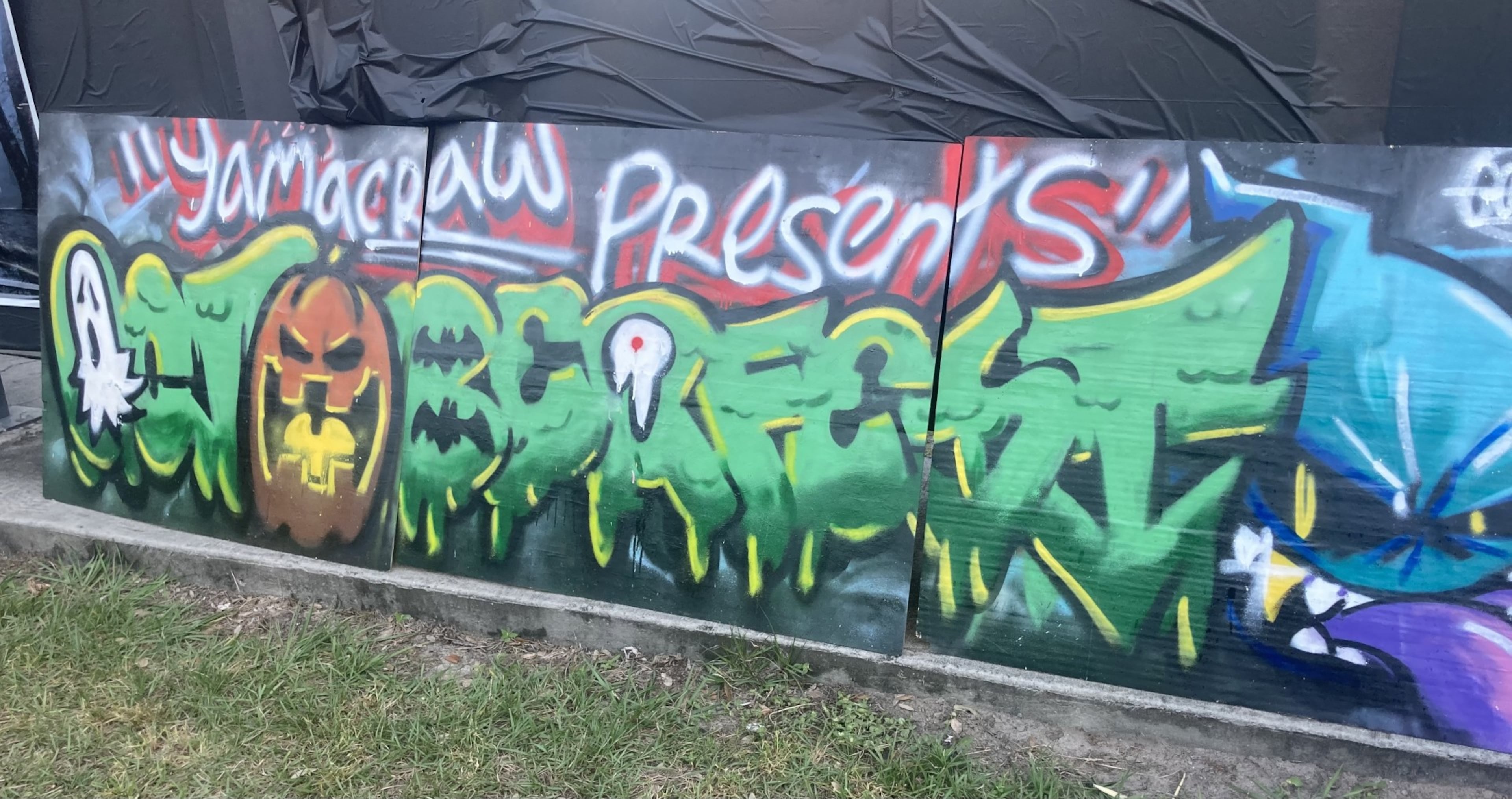
The Yamacraw Residents’ Council hosted a trick-or-treat party dubbed “Octoberfest” for neighborhood children on Friday, Oct. 31, 2025. (Adam Van Brimmer/AJC)
Clarification
This story has been updated to clarify when tenants with vouchers can lose their housing because of changes in income.

Adam Van Brimmer is a journalist who covers politics and Coastal Georgia news for The Atlanta Journal-Constitution.