The “Lock-in Effect” and Mortgage Rates: Update on Unwinding a Phenomenon that Wrecked
This is going to take a long time to get worked out.
By Wolf Richter for WOLF STREET.
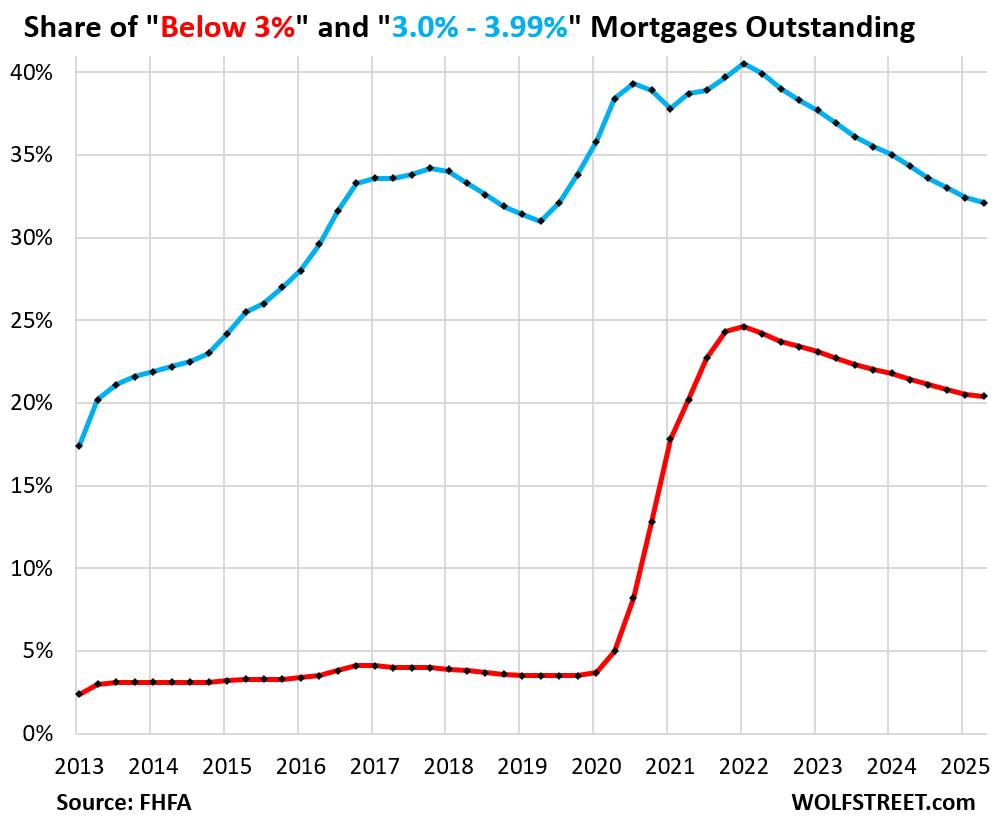
The share of below-3% mortgages outstanding declined in Q2 to 20.4% of all mortgages outstanding, the smallest share since Q2 2021 (red in the chart), according to data by the Federal Housing Finance Agency. The share has been shrinking since the peak in Q1 2022, but the pace has been very slow: Just 4.2 percentage points in three years. The shrinking share of these ultra-low-rate mortgages documents the slow exit of homeowners and investors from the “lock-in effect.”
The share of 3%-3.99% mortgages declined by 30 basis points to 32.1%, the smallest share since Q3 2019 (blue).
When these ultra-low mortgage rates came along in early 2020, they triggered a tsunami of refinancing, and the number of these outstanding low-rate mortgages exploded through Q1 2022, when 65% of all mortgages outstanding had interest rates of 3.99% or below:
All types of mortgages are included here, such as 30-year fixed-rate mortgages, 15-year fixed-rate mortgages, and Adjustable-Rate Mortgages.
These below 3%-mortgages are free money in real terms because inflation is currently running at about 3% and accelerating, and if borrowing costs run at the rate of inflation or below, it equates to getting free money.
These mortgages were a result of the Fed’s reckless monetary policies that caused home prices to explode in many markets by 50% and much more in just two years, and those too-high home prices and ultra-low mortgage rates have now locked up the housing market for three years.
These homeowners have been altering the course of their lives by avoiding to move, or by not being able to afford to move, which would require losing an ultra-low mortgage and buying the next home at a price that had exploded by 50% or more in a couple of years to an absurd level, and then financing this absurd price at a historically normal rate.
But life happens: career-moves, divorces, deaths, family additions, etc., and so a small number of those mortgages get paid off every quarter anyway, and their share shrinks slowly. It will take years to get this worked out.
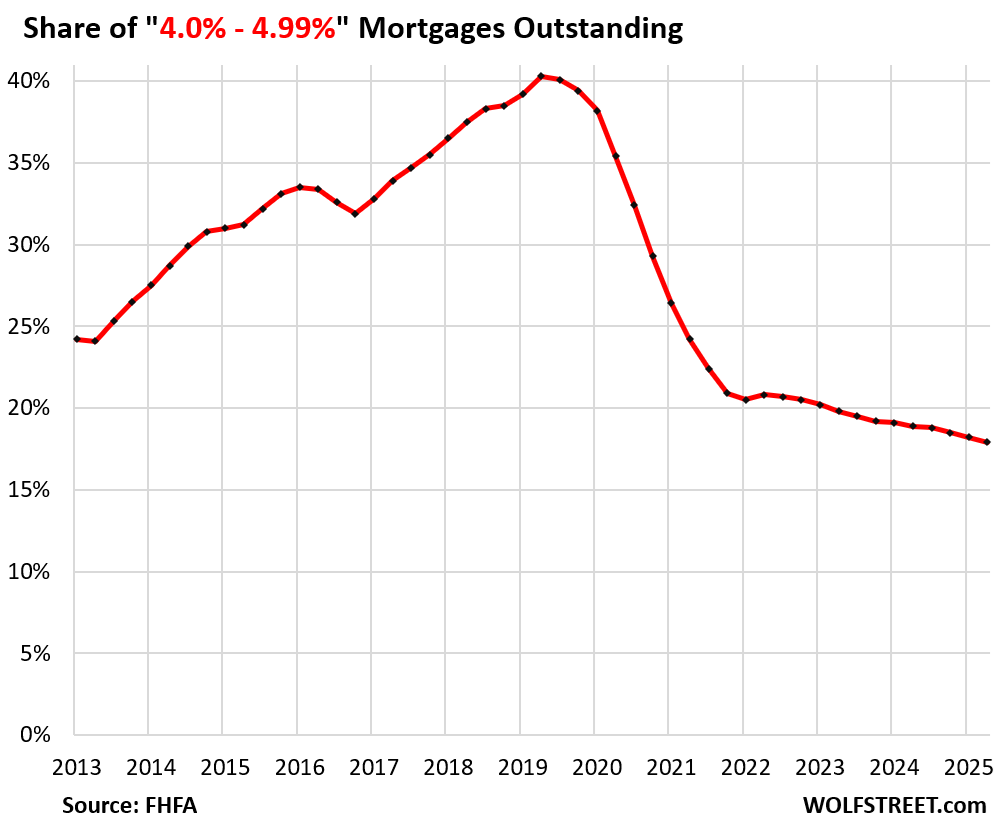
The share of 4.0% to 4.99% mortgages declined to 17.9%, the lowest share in the FHFA’s data going back to 2013, and down from the peak in 2019 of 40%.
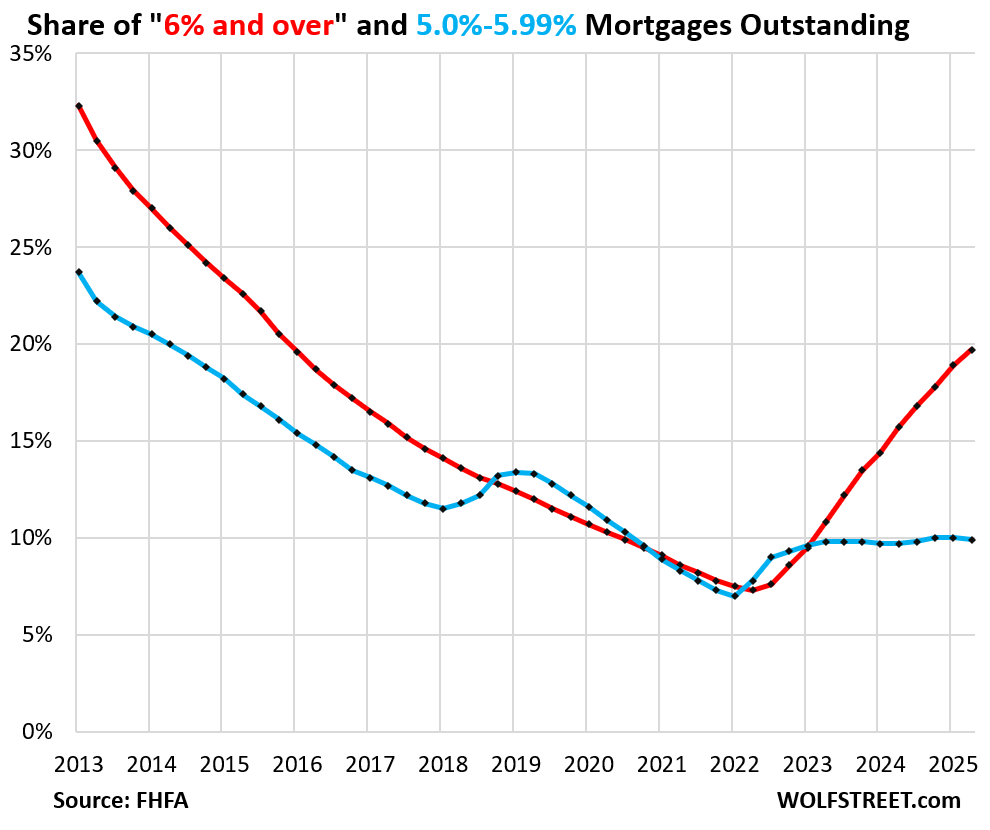
Conversely, the share of 6%-plus mortgages rose 19.7% of all mortgages in Q2, the highest since Q4 2015, up from a share of 7.3% at the low point in Q2 2022 (red in the chart below).
The increase is so slow because home sales have plunged and refinancings have collapsed, and so demand for mortgages has plunged, and a much smaller number of mortgages are being originated.
The share of 5.0% to 5.99% mortgages has remained roughly stable over the past two years, around the 10%-line. In Q2, the share was 9.9% of all mortgages outstanding (blue).
There are currently fixed-rate mortgages offered in this range. For example, the interest rate of the average conforming 15-year mortgage was 5.49% in the latest week, according to Freddie Mac. The Navy Federal Credit Union, for example, quotes 30-year-fixed VA loan rates “as low as” 5.375%.
So new mortgages in that rate bracket are currently being originated at about the same pace as old mortgages are being paid off.
The below-5% average 30-year fixed mortgage was a creature of the Fed’s QE. They didn’t exist until the Fed started buying trillions of dollars of securities, including Mortgage-Backed Securities, starting at the beginning of 2009, and then massively in 2020 through early 2022, which produced the below-3% mortgages.
But since mid-2022, the Fed has been attempting to tamp down on some of the damage – the historic home price explosion and the surge of consumer price inflation – with its QT. By now it has shed $2.36 trillion in assets, and that continues.
The ultra-low-rate mortgages were a brief phenomenon in historical terms – though people now believe that they were normal, and that the current rates are too high. What’s too high are home prices, not mortgage rates.
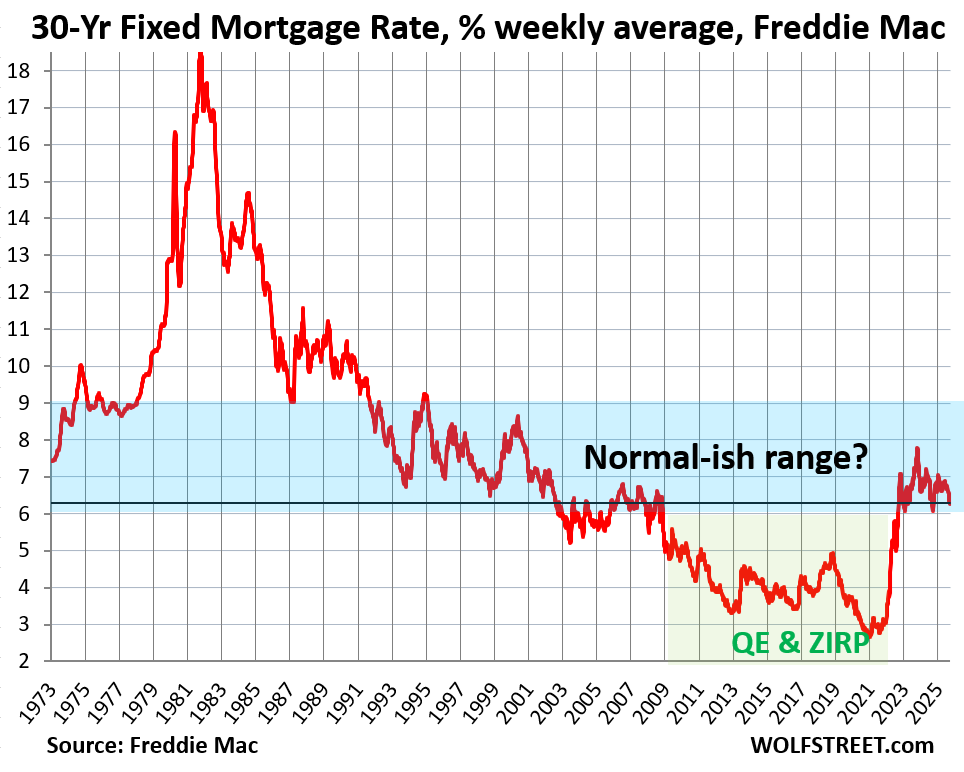
The data from the FHFA on the share of mortgages by rates goes back to only 2013, and only reflects the era when QE had already repressed mortgage rates.
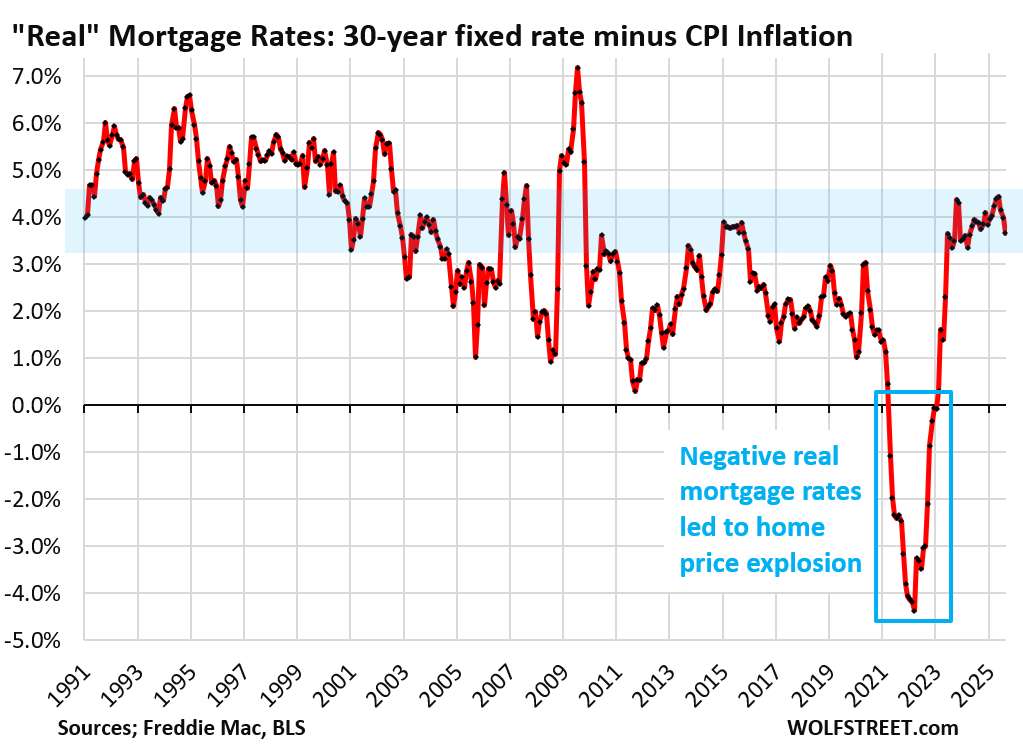
Just how crazy were those ultra-low mortgage rates? Between early 2021 through 2022, the average 30-year fixed mortgage rate was below CPI inflation – meaning negative “real” mortgage rates, better than free money!
At the peak of this craziness, “real” mortgage rates were 4 percentage points below CPI, with mortgage rates below 3% and CPI inflation exceeding 7%. Those were the craziest times ever in the mortgage market, and they wrecked the housing market through a historic home price explosion (now being unwound in many markets) and then the lock-in effect.
Enjoy reading WOLF STREET and want to support it? You can donate. I appreciate it immensely. Click on the mug to find out how: